
NANO operator guide: what you earn and when
The full payout model for NANO operators: 60% of every session fee, a guaranteed $37 slot, a pooled $37 slot, the uptime bar, and when each part reaches your wallet.
in this article
- what a session pays
- the monthly bonus: two slots per NANO
- why half of it is earned
- how the pooled slot is worked out
- what this means in practice
- what you have to do: stay online
- joining part-way through a month
- when you get paid
- session earnings
- the two slots
- claiming early
- what price your $YOM is converted at
- how this is run
- everything on one page
Running a YOM node earns you money from two places at once. Here is exactly what each one pays, what you have to do to qualify, and when it arrives in your wallet.
Applies to all live NANO operators.
Your monthly payout is made of two separate things, and it helps to think of them separately because they work in completely different ways.
The first is your share of what players spend on your machine. Every game session played on your node is paid for, and you get a cut. The second is a monthly bonus of two slots, which exists so that running a node is worth doing now, while the network is still growing into projected saturation.
| what it pays | |
|---|---|
| Session share | 60% of every session fee your node serves: $0.048 for a Standard session, which costs $0.08 |
| Guaranteed slot | $37 for a full month meeting the uptime requirement, whatever your session count |
| Pooled slot | $37 per NANO, paid into one shared pool and divided by how many sessions each node actually served |

Session earnings arrive continuously as players use your node. The monthly bonus is two slots of $37: the first is guaranteed for being available, the second is pooled across the fleet and shared out by the sessions each node served. All three add together, and nothing is deducted from anything else.
what a session pays
Every completed game session pays a fixed fee set by its compute tier: the resources the session reserves on your machine.
| tier | session fee | your 60% |
|---|---|---|
| Light | $0.04 | $0.024 |
| Standard | $0.08 | $0.048 |
| Premium | $0.16 | $0.096 |
| Ultra | $0.24 | $0.144 |
That fee is used to buy $YOM on the open market, and the tokens are then split four ways:
- 60% goes to you, the operator whose node served the session.
- 30% funds network development, the development and growth of the network.
- 5% is the holders’ share, shared with everyone who holds on to their payout.
- 5% is retired, permanently removed from supply. Every session played on the network makes $YOM slightly scarcer.
Worth being clear about one thing: the full session fee is bought on the market, not just your share. Every session played on the network is a real market buy of $YOM, and a real retirement of supply.
the monthly bonus: two slots per NANO
While the network is still building demand, session earnings alone would not make a node worth running yet. So there is a bonus, and it is worth $74 per NANO per month, counted as two slots of $37.
It is paid from the ecosystem wallet, which is the 25% of supply set aside for node operators and replenished through network rewards. Session earnings come from players; the two slots come from that allocation. See the $YOM token for how the allocation is structured.
One slot is guaranteed. The other is earned.
Slot one is yours for staying available. Meet the uptime requirement for the month and you receive $37, regardless of how many players were routed to you. This is a floor, and it does not depend on anything you cannot control.
Slot two goes into a pool. Every qualifying NANO’s second slot is added together into one pot for the month, and each node draws from it in proportion to the sessions it actually served. Serve 10% of the network’s sessions that month and you receive 10% of the pool, which may be considerably more than $37, or considerably less.
why half of it is earned
A bonus that paid every node the same amount, whether it served seven sessions or seven hundred, would reward nothing you can actually influence. An operator who invests in a better machine, a better connection, or a location where players actually are would see nothing for it. And a node that is merely switched on, however poorly it performs, would collect as much as the best node on the network. Neither is a system that can grow into real demand.
So half the bonus is guaranteed for being available, and half follows the work your node actually did.
Why two slots. A NANO comes with two node licences, which together run one Standard stream, and the bonus counts one slot for each licence. Slot one is guaranteed for being available. Slot two is shared out by contribution, so it follows the work your node actually did.
Why $37 a slot. That is our minimum expected return for a single licence once the network is carrying real traffic, and we took it from the lower end of the saturation range rather than the middle or the optimistic end.
how the pooled slot is worked out
Three steps, and they run once when the month closes:
- Add up the pool. Every NANO that met the uptime requirement contributes its second slot. Thirty qualifying NANOs for a full month makes a pool of 30 x $37, so $1,110.
- Add up the sessions. Count every completed session served by those same qualifying NANOs.
- Divide the pool by session share. Your share of the pool is your sessions divided by that total.
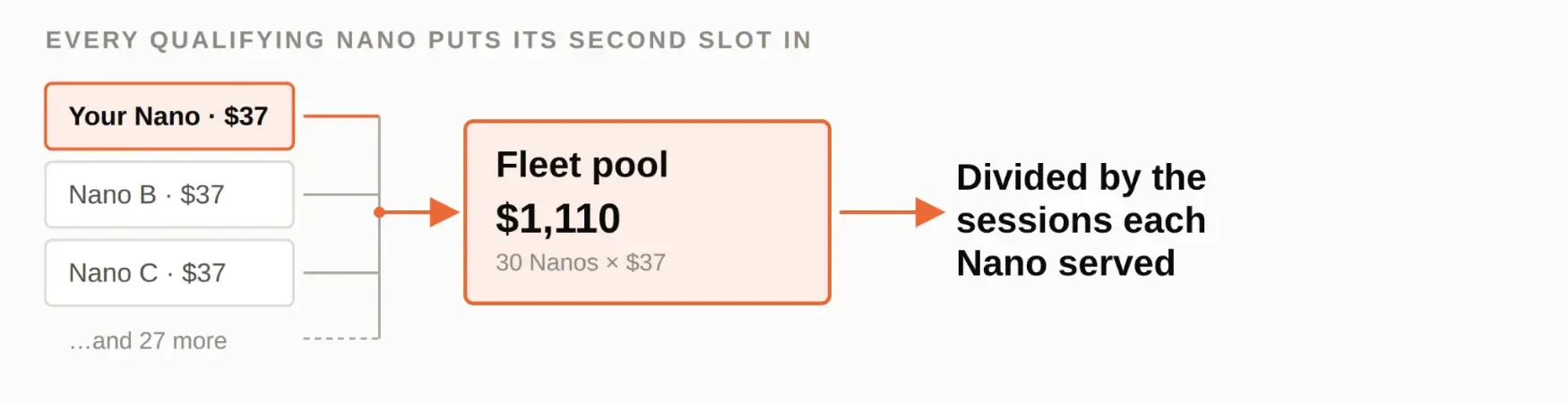
Every qualifying NANO contributes its second slot, and every qualifying NANO draws back out in proportion to the sessions it served. The figures below are an example.
Suppose those thirty NANOs served 3,000 Standard sessions between them. The total adds your guaranteed $37, your draw from the pool and $0.048 for each session served:
| sessions served | drawn from the pool | total for the month |
|---|---|---|
| 300, a tenth of the total | $111.00 | $162.40 |
| 30 | $11.10 | $49.54 |
| 0, with full uptime | nothing | $37.00 |
There is no minimum session count to take part. A node with two sessions gets a small share, and a node with none gets nothing from the pool and keeps its guaranteed slot. Nothing is withheld for falling below a threshold, because there is no threshold.
what this means in practice
Busier nodes earn more. If your machine is handling a large part of the network’s traffic, you will be paid for it, and there is no cap. If your session share is big enough, the pool can pay you well above $74.
Quieter nodes land nearer the floor. If your node qualifies on uptime but serves fewer sessions, you will land closer to $37 than $74. Your guaranteed slot is untouched and your session earnings are untouched. It is the second slot that depends on how much work your node took on.
Your session earnings are yours on top. Session earnings and the two slots are added together, so every session you serve raises your total twice: once through your 60% of its fee, and again through your share of the pool.
what you have to do: stay online
Both slots are earned by being available, not by being busy. You cannot control how many players get routed to you, so that is not what qualifies you.
The requirement is 6 hours a day, averaged across the month. A few things to know about how that is counted:
- It is measured in real minutes online, from the regular check-ins your node sends. Time your node is powered off, offline or unreachable does not count.
- The bar is firm, and it governs both slots. Meeting it pays your guaranteed slot and lets you share in the pool. Falling short pays neither, and there is no partial credit. If you are close to the line, it is worth leaving the machine running.
- Your sessions are also removed from the pool maths if you miss the requirement, so the pool is divided only among the nodes that qualify.
You can see your uptime against the requirement in the operator app while the month is still running, so you are never guessing whether you are on track.
If your node misses the requirement, you still keep every cent of your session earnings. Those are never withheld. You lose only that month’s two slots, and the following month starts clean.
joining part-way through a month
If your node joined part-way through a month, everything is pro-rated to the days you were actually running.
Your uptime requirement is scaled to those days, and your guaranteed slot is scaled the same way. A node onboarded on the 17th of a 31-day month has a guaranteed slot of around $18 rather than $37.
The amount you contribute to the pool is scaled identically. A node that joined on the 28th of a 31-day month contributes four days’ worth, about $4.77, rather than a full $37. That is deliberate, and it is what makes joining late fair in both directions: you put into the pool exactly what you receive as your guaranteed slot, and you serve only part of a month’s sessions, so the two match.
It does not cap what you can draw out. A node with only a few eligible days that was genuinely busy in them can take considerably more from the pool than it contributed.
From your first full month onward you are on the full amount.
when you get paid
session earnings
These are paid out automatically as they accumulate. Once you have built up 10 completed sessions since your last payout, your earnings are sent to your wallet without you doing anything.
About that number. The 10-session threshold may change. It exists so that the blockchain transaction fee for sending your payout never eats a meaningful share of the payout itself. Those fees move with network conditions, so if they rise the threshold may rise with them, and if they fall it can come down. We will always set it so that more of your earnings reach you than are spent delivering them.
You do not pay anything for an automatic payout. The transaction fee on those is covered by YOM.
the two slots
Paid once a month, shortly after the month closes, for the month just ended. The pool cannot be divided until the month’s sessions are final, so this leg cannot arrive any earlier than that.
claiming early
Everything above happens on its own. If you would rather not wait, the operator app at app.yom.net has a Claim button that sends what you are owed to your wallet on demand, both your session earnings and any accrued monthly slots, in one action.
On a manual claim you pay the network fee yourself, in AVAX, from your own wallet. Automatic payouts have that fee covered by YOM. The difference is not small: claiming on your own costs roughly four times the gas of the same payout inside an automatic batch, because a batch spreads one transaction across many operators.
Before you sign, the app shows you an estimate of the fee against the value of what you would receive, and warns you if the fee would exceed the payout. It is an estimate. Your wallet shows the exact figure before you confirm, and that is the one that counts. There is no minimum claim amount, and whether a small claim is worth the fee is your call, not ours to make for you.
Claiming early does not change what you are owed. It does not increase it and it does not reduce it. It only moves it sooner, and costs you the fee to do that. So if you are not in a hurry, waiting is simply cheaper. See Claiming your $YOM for the steps.
what price your $YOM is converted at
Your earnings are worked out in dollars and paid in $YOM, so a rate has to be applied somewhere. The two parts use different ones, and that is deliberate.
Session earnings convert at the real-time price. Your share is bought on the open market in the same transaction that pays you out, so the rate you get is simply the rate the market gave at that instant. Nobody picks it, including us.
The two slots convert at the midnight price, which is the $YOM price at midnight as the month closes. The slots are not bought on the market, so there is no execution price for them to inherit. Fixing them to one published moment means every operator’s bonus for a given month converts at exactly the same rate, rather than at whatever the price happened to be when their particular transfer went out.
The practical consequence is that the token amount of your monthly slots is settled when the month closes, not on the day it lands. If the price moves between those two points, the tokens you receive do not change.
how this is run
The whole payout process is automated, and it is running on our test network now. Once it is live:
- Session earnings arrive continuously, every time you cross the session threshold.
- Buying, splitting and retiring supply happen in a single on-chain transaction, so every payout is publicly verifiable rather than resting on our arithmetic.
- The monthly slots run on a schedule, calculated from your node’s own uptime and session record.
Beyond that, the pooled slot is the first step toward paying for quality and not just presence. As we add per-session scoring and XP, how much work the network sends your node will increasingly reflect how well it performs, and because the pool follows sessions, that will show up directly in what you are paid.
everything on one page
| Per session | 60% of the session fee to you: $0.048 for a Standard session ($0.08), from $0.024 for Light to $0.144 for Ultra |
| Guaranteed slot | $37 for a full month meeting the uptime bar, pro-rated by days if you joined mid-month |
| Pooled slot | $37 per NANO into one pool, divided by each node’s share of completed sessions |
| Budget per NANO | $74 a month, half guaranteed and half earned |
| Session earnings | paid on top of both slots, never deducted from them |
| Uptime needed | 6 hours a day across the days you were expected to be running |
| Minimum sessions | none |
| Joined mid-month | slot 1, your pool contribution and your uptime target all scale to your days |
| Session payouts | automatic every 10 sessions, fee paid by YOM |
| Slot payout | monthly, after the month closes |
| Claim early | Claim button in the operator app, any time. You pay the gas fee in AVAX |
| Conversion rate | sessions at the real-time price, slots at the midnight price when the month closes |
| Miss the uptime bar | you keep session earnings, lose both slots for that month |
Can't sign in, or don't have an account yet? Email support@yom.net
5 / 14 operating a YOM node
all articles